Loading Campussutras...

Move Beyond Simple Chatbots — Architect Enterprise RAG Pipelines & Autonomous Multi-Agent Workflows.
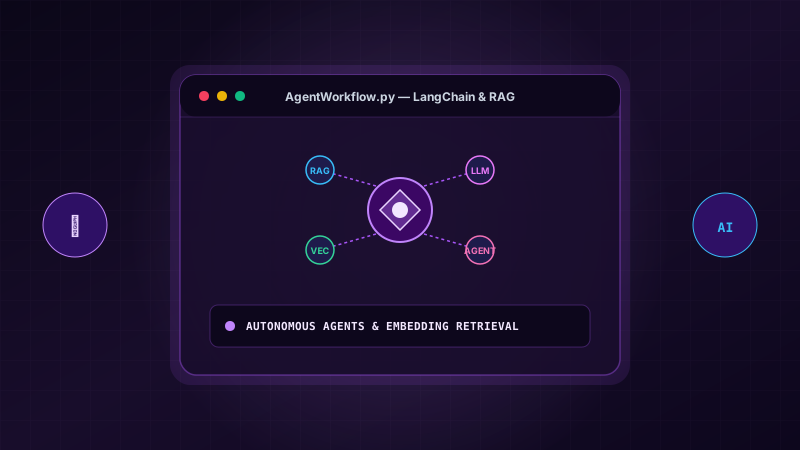
Generative AI has shifted software development from deterministic code to probabilistic, intelligent systems. This flagship 90-day program teaches you how to design, deploy, and evaluate production-grade AI systems.
You will progress from advanced prompt engineering and tokenomics to architecting production Retrieval-Augmented Generation (RAG) pipelines using vector databases (Pinecone, Chroma, pgvector), chunking strategies, hybrid keyword-semantic search, and rerankers.
You will then master autonomous multi-agent orchestration using LangChain, LlamaIndex, and CrewAI—creating self-reflective AI agents that collaborate, use external tools, call APIs, and execute complex workflows without manual supervision.
Design structured prompt architectures with few-shot learning, chain-of-thought, and JSON schemas
Build production RAG pipelines with semantic chunking, embedding models, and reranking
Orchestrate autonomous multi-agent systems that utilize tools, APIs, and web search
Implement model evaluation frameworks with hallucination detection and response quality metrics
Deploy scalable AI microservices with FastAPI, streaming responses, and Docker containers
Our industry-aligned syllabus is partitioned into 4 high-impact milestones, taking you systematically from core concepts to enterprise deployment.
Master LLM architectures, tokens, temperature, context windows, and advanced prompt engineering.
You will build, test, and deploy production-grade software applications to create a verifiable GitHub portfolio that proves your capabilities to hiring managers.
Hybrid RAG intelligence platform with pgvector, LangGraph & CrewAI multi-agent collaboration.
An enterprise-grade autonomous intelligence platform that ingests unstructured PDFs, financial statements, and technical documentation. Features a Hybrid RAG retrieval pipeline combining pgvector with Cross-Encoder rerankers, a CrewAI multi-agent team (Document Analyst, Fact Checker, and Report Writer), automated citation verification, and a streaming FastAPI backend deployed in a Docker container.
Demonstrates production mastery of Retrieval-Augmented Generation, vector embeddings, multi-agent coordination, and cloud deployment demanded by modern AI startups and enterprises.
Everything you need to know about the Applied Generative AI & Autonomous Agent Engineering program, mentorship, and credentials.
No. This course focuses on Applied Generative AI engineering—building software systems on top of state-of-the-art foundation models through APIs, RAG pipelines, and agent frameworks. Basic Python proficiency is all you need.